All roles/Engineering/First Engineer
Engineering
First Engineer
The First Engineer runs the engine room day to day under the Chief Engineer, keeping propulsion, power, water and hotel systems working so the yacht can sail and guests notice nothing.
- Department
- Engineering
- Reports to
- Chief Engineer
- Yacht size
- 65m to 150m+
- Contract
- Rotation or permanent
- Starting pay
- €6,500 per month
What the job is
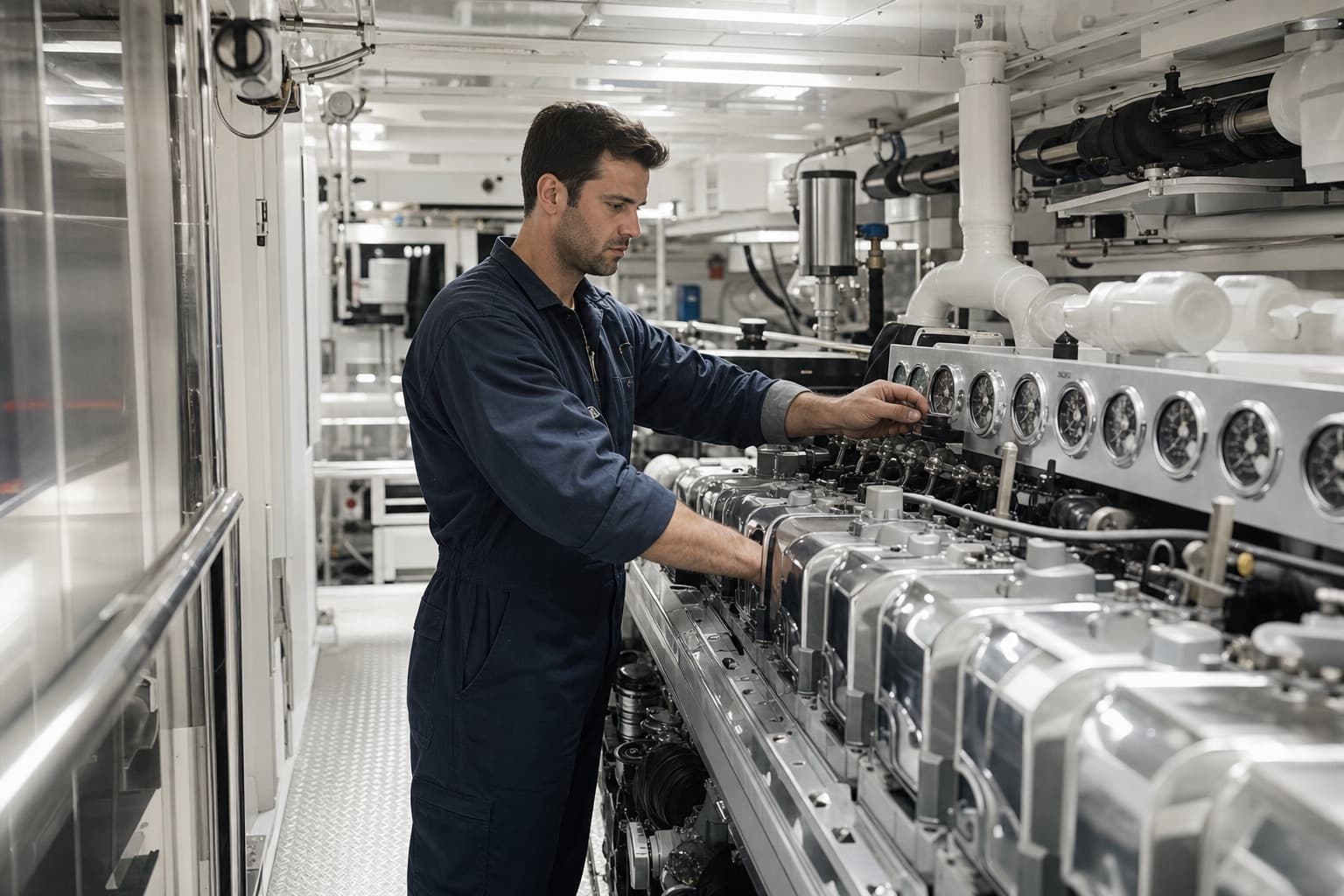
You are the second most senior engineer on board and the Chief's right hand. On most yachts of this size the Chief handles budgets, yard planning and management company paperwork, while you run the engine room floor. That means main engines, generators, watermakers, sewage plants, stabilisers, fuel transfers and the endless list of hotel systems guests depend on. When something fails at 02:00, you are usually the first one down the ladder.
Much of the job is planned maintenance. You work through the PMS, schedule jobs for the Second and Third Engineers, order spares and keep records clean enough for class surveyors and flag inspectors. You stand engineering watches on passage, carry out bunkering, and take charge of the department whenever the Chief is ashore or on leave. Many First Engineers also supervise contractors during refits and shipyard periods.
Captains and Chiefs hire for judgement as much as tickets. You need to fault find calmly with guests on board, explain problems clearly to the bridge, and train junior engineers without slowing the work. Good First Engineers know every valve and breaker on the vessel and can tell from a sound or a temperature trend that something is about to go wrong. This role is the usual stepping stone to Chief Engineer on a large yacht.
What makes a good one
- Fault finding under pressure
- Planned maintenance systems
- Diesel engines and generators
- Leading junior engineers
- Clear reporting to the bridge
A day in the life

- 06:30Engine room rounds with the night log. Check generator load, fuel and water levels, watermaker output and any alarms from overnight.
- 07:15Quick meeting with the Chief and Second Engineer. Agree the day's PMS jobs and what can and cannot be done with guests on board.
- 08:00Help the deck team launch the tenders and toys, then check the tender engines and jet skis are fuelled and running cleanly.
- 09:30Service a generator while the other carries the load. Change filters, take oil samples and record running hours in the PMS.
- 12:00A guest cabin reports no cooling. Trace it to a failed fan coil valve, swap it from spares and get the cabin cold before guests return from lunch.
- 14:00Order spares for next month and update the inventory. Chase a supplier in Palma for a stabiliser seal due before the next charter.
- 16:30Recover tenders with the deck crew, flush the toys and check hydraulic systems on the swim platform and crane.
- 19:00Pre-dinner rounds and a final check on the sewage treatment plant, which is working hard with a full guest load.
- 21:00Hand over to the duty engineer for the night and stay on call. Write up the day's work in the engine log.
Pay by country
Monthly salary in local currency for a First Engineer on a 65m to 100m yacht, rising above this on 100m+ vessels and for Y2 or Y1 holders. Rotational posts often pay at the top of the range. Charter tips can add a further €2,000 – 6,000 a month in a busy season.
- France and Monaco
- €6,500 – 9,000
- Spain
- €6,500 – 9,000
- Italy
- €6,500 – 9,000
- United Kingdom
- £5,600 – 7,700
- USA (Florida)
- US$7,000 – 9,800
- Caribbean
- US$7,000 – 9,800
- UAE
- AED 25,500 – 35,500
- Australia
- A$10,800 – 15,000
- New Zealand
- NZ$11,800 – 16,500
Required
- STCW Basic Safety Training
- ENG1 medical
- PDSD
- MCA Yacht Engineer Y3 (Y2 on larger yachts)
- Advanced Fire Fighting
- Medical First Aid
- Proficiency in Survival Craft
Recommended
- HELM (Management)
- MCA Y1 modules
- Manufacturer courses (MTU, Caterpillar)
- Ship Security Officer
- RYA Powerboat Level 2
- Medical Care
Visas
- Schengen
- US B1/B2 or C1/D
- Australian MCV
Where it leads
First Engineer jobs open now
Questions crew ask
Do I need a Y2 to be a First Engineer?
On yachts up to around 3000gt a Y3 is often enough. On larger vessels, or where you must cover for the Chief, a Y2 is usually expected.
What is the difference between a First and a Second Engineer?
On big yachts the First Engineer is the Chief's deputy and runs the department when the Chief is away. The Second Engineer works under the First, handling a set share of the maintenance and watches. On smaller yachts the titles can overlap.
Is rotation common for First Engineers?
Yes. Many yachts over 70m offer rotations such as 10 weeks on and 10 weeks off, or 2:1, usually with a slightly different salary from a permanent post.