All roles/Engineering/Marine Engineer
Engineering
Marine Engineer
A Marine Engineer keeps a superyacht's engines, generators and hotel systems running, working shifts in the engine room under the Chief Engineer so the yacht can cruise, host guests and stay safe.
- Department
- Engineering
- Reports to
- Chief Engineer
- Yacht size
- 40m to 150m+
- Contract
- Permanent or rotation
- Starting pay
- €4,500 per month
What the job is
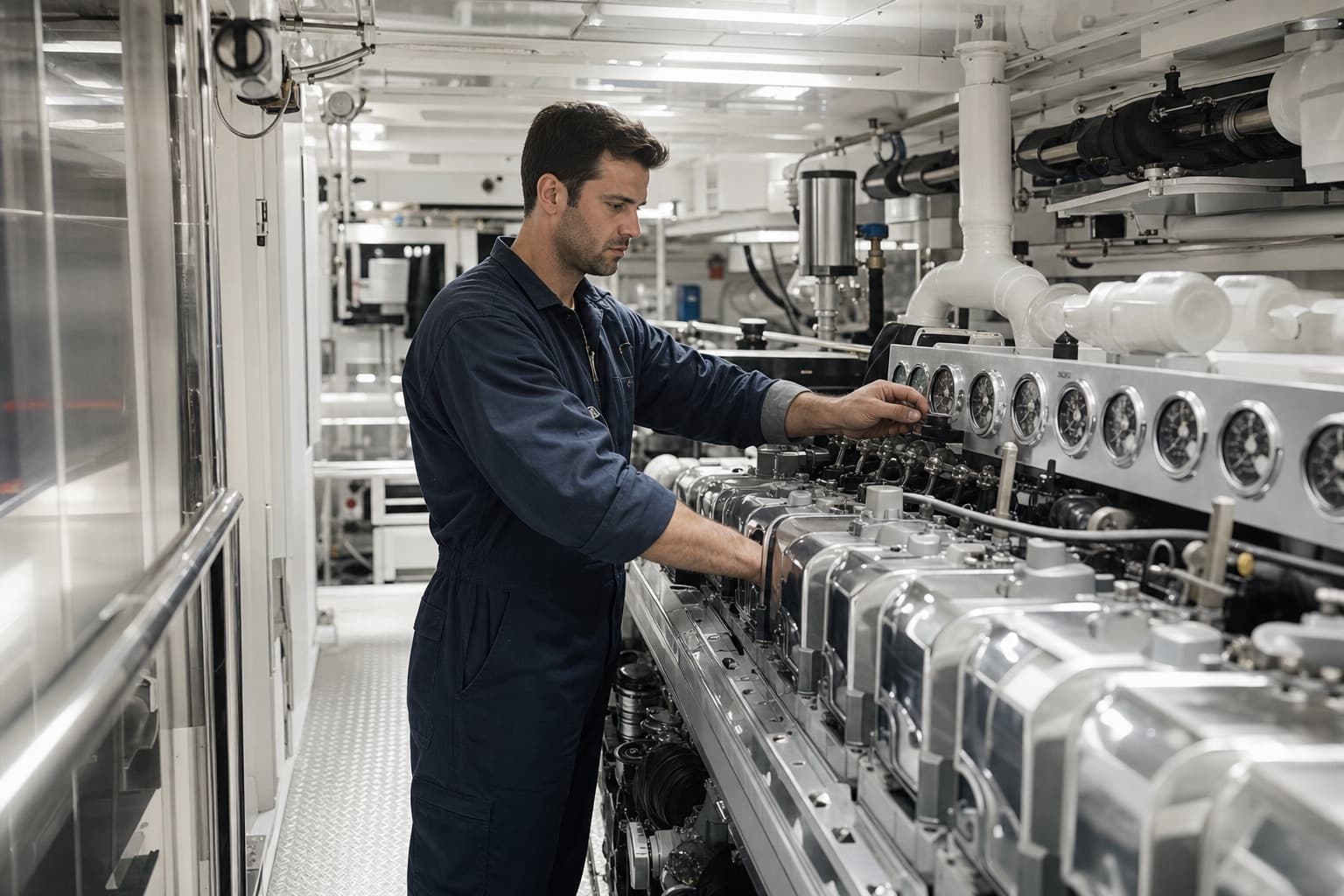
A Marine Engineer is a hands-on member of the engine department. You run and maintain the main engines, generators, watermakers, sewage plant, air conditioning and fuel systems. On a 50m yacht you might be one of two engineers. On a 100m yacht you sit inside a team of four or five, covering a set of systems and standing watches in the engine control room. The title often goes to engineers who have come across from commercial shipping or shoreside marine trades.
Most of the work is planned maintenance. You follow the yacht's maintenance software, change filters and impellers, take oil samples, service pumps and log running hours. When something fails, you find out why and fix it, often with guests on board and no shipyard nearby. You also handle bunkering, keep the bilges clean and dry, manage spares and write up reports so the Chief Engineer can plan the budget and the next yard period.
Yacht engineering differs from commercial work in one way above all: the guest never notices you if you do the job well. Air conditioning must hold 21 degrees, the hot water must never run cold and the tenders must start first time. You will help the deck crew with tender launches, water toys and mooring stations, and you will work long days in season. In return the pay is strong and the hands-on experience builds quickly towards a higher ticket.
What makes a good one
- Diesel engine and generator maintenance
- Fault finding on hydraulic and electrical systems
- HVAC and watermaker operation
- Planned maintenance software and logs
- Calm work under guest pressure
A day in the life

- 06:30Morning rounds of the engine room. Check generator load, oil and coolant levels, bilges, watermaker output and any alarms from the night.
- 07:30Brief with the Chief Engineer over coffee. Agree the day's jobs around the guest programme and the planned move to a new anchorage at midday.
- 08:30Help the deck crew launch the tenders and jet skis. Check fuel, run the engines and fix a sticking kill cord switch on one of the skis.
- 10:00Planned maintenance on the standby generator: change fuel filters, take an oil sample and log the work in the maintenance system.
- 12:00Prepare the main engines and stand by in the engine control room for the passage, watching temperatures and pressures until the anchor is down.
- 14:00A guest cabin reports it is too warm. Trace the fault to a blocked fan coil filter, clean it and confirm the temperature with the interior team.
- 16:30Run the watermaker, test the sewage plant and record tank levels so the Chief Engineer can plan the next bunkering and provisioning stop.
- 19:00Recover tenders and toys with deck, then wash down and refuel. Final rounds before handing over to the engineer on night duty.
- 21:00Write up the day's log, order a replacement impeller and finish for the night, on call if an alarm sounds.
Pay by country
Monthly salary for crew on yachts of 40m to 100m, paid in EUR or USD whatever the flag. Larger yachts and rotation roles pay at the top of the range. Charter yachts add tips, often €1,500 – 4,000 a month in a busy season.
- France and Monaco
- €4,500 – 6,500
- Spain
- €4,300 – 6,200
- Italy
- €4,300 – 6,200
- United Kingdom
- £3,800 – 5,500
- USA (Florida)
- US$4,900 – 7,000
- Caribbean
- US$4,900 – 7,000
- UAE
- AED 18,000 – 26,000
- Australia
- A$7,400 – 10,700
- New Zealand
- NZ$8,100 – 11,700
Required
- STCW Basic Safety Training
- ENG1 medical
- PDSD
- AEC 1 and 2
- MEOL (Yacht) or higher engineering CoC
Recommended
- MCA Y4 (Yacht)
- HELM (Operational)
- Advanced Fire Fighting
- Medical First Aid
- RYA Powerboat Level 2
- RYA PWC
Visas
- Schengen visa
- US B1/B2 or C1/D
- Australian MCV
Where it leads
Marine Engineer jobs open now
Questions crew ask
Can I move from commercial shipping to yachts as a Marine Engineer?
Yes, and many engineers do. Commercial CoCs are recognised, though you may need to show yacht experience on smaller systems like tenders, toys and HVAC, so a season on a 50m yacht is a good start.
Do I need a Y4 to get hired?
Not always. Many yachts under 3000gt will hire with AEC 1 and 2 plus MEOL (Yacht), but a Y4 or commercial equivalent opens more senior posts and better pay.
Is rotation common for engineers?
It is common on yachts over 60m, often on a 2:2 or 3:1 pattern. Smaller yachts usually want permanent crew with set leave.